Items
-
-
247 Church Street residence
This is the view of the new Saint Mary's RC Church a few doors down from 247 Church Street. In Harriet's time, the older church would have been there, but it burned down in a fire November 1968, and was replaced by a gift of the James McCann Foundation. Jim McCann had been a lifelong member Saint Mary. Just around the corner we find The former Presbyterian Church, something very important in Harriet Wickes Winslow's life. Like Saint Mary, the original Presbyterian Church suffered a fire. Edmund Platt in his History of Poughkeepsie which ends at 1905 writes of the magnificent new Presbyterian Church under construction at the corner of Hamilton and Cannon Street. The structure has been sold to another Christian group, and the dwindled Presbyterian congregation merged with the Presbyterian Church on route 55 near the Taconic Parkway. Sources indicate that Harriet Winslow contributed over half the funds for the construction. Inside there is a large stain glass window in honor of her husband John F Winslow, and a small chapel/meditation room named in her honor. Harriet Wickes Winslow furnished this stained glass in memory of her late husband, John Flack Winslow, who died in 1892. The new church was under construction around 1905, and she was the principal donor to construction of the church. The Marist College music and choral groups hold an Advent concern within the church each year. Harriet Wickes Winslow is buried with her husband in Albany Rural Cemetery. I like to think this beautiful church is her memorial for us here in Poughkeepsie.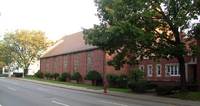
-
247 Church Street residence #1
Harriet Wilkes Winslow and her friend Sophie Harris lived in this house in the last few months/years of Harriet's life. Sophie lived here until she died in March 1932. This photo, taken 6 October 2012 shows a two family house. The house to the immediate left was demolished after a fire, and it seems that 247 also may be subject to the same fate. Why did they move there? My guess is that the Winslow estate was too large for the small surviving group. Thomas Scudder Winslow was a physician living in Newburgh, Mary Corning Winslow Black had moved away from New York, first to Michigan, then to California. The residence at 247 had some advantages. it was less remote from city activities and medical assistance. (the 1920 census for the Winslow estate lists only Harriet, Sophie, a nurse and a cook). Of all the places to choose, I guess they chose this for its proximity to the Presbyterian Church at the corner of Cannon and Hamilton Street. 247 Church Street is on the same block as Saint Mary Church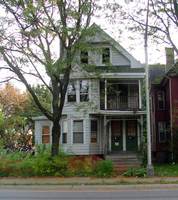
-
Winslow Mausoleum
The Winslow mausoleum in Albany Rural Cemetery, final resting place of John Flack Winslow and Harriet Wickes Winslow.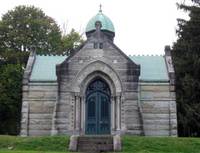
-
Eastman Terrace
The Eastman Terrace row houses were modeled on those on the northeast section of Washington Square in New York City. John Winslow participated in the real estate transactions for Eastman Park. In particular he purchased the land between Franklin street to the back of these houses. Eastman Park extended from South Avenue to Jefferson Street; it is bounded on the south by Franklin Street and on the north by Montgomery Street. The YMCA building at the upper right hand occupied the corner of Montgomery and South Ave. Built in the 1960s it now sits empty. Stitzel Field is inside Eastman Park at the far corner of Montgomery and Jefferson Streets; it is used for football, baseball and softball.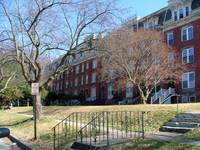
-
Monitor Cannon
The first picture shows the cannon from the Monitor stands in front of the Adriance Memorial Library entrance along Market Street in Poughkeepsie NY. The second picture shows the dedication dedicated to Capt. John Ericsson. THE MONITOR of 1863 fame the invention of Capt. John Ericsson was the first war vessel carrying am armored turret. It was made through the efforts of John F. Winslow and John A. Griswold and with money furnished by them. This cannon made for the Monitor was presented to the CITY OF POUGHKEEPSIE by Mary C. W. Black Mr. Winslow's daughter 1926 Mary Corning Winslow Black was the daughter of John and Harriet Wickes Winslow. Mrs. Winslow died in 1926 and Thomas Scudder Winslow and Mary Corning Winslow sold the estate to John Marian. Mary and her husband first lived in Michigan, but by 1926 had moved to California. The third picture shows the entrance to the Adriance Library faces Market Street.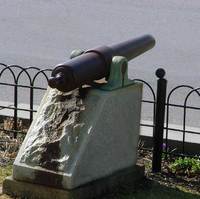
-
Poughkeepsie & Eastern Railroad
The diameter of these three trees along the P & E path indicate how long it has been since it was in use as a railroad.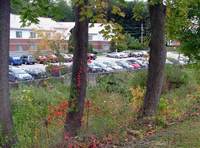
-
Poughkeepsie & Eastern Railroad
The trail runs behind Staples and Home Depot. Again the power towers are the easiest indicators of the route to the former Hudson River State Hospital. When I was a student (1947-1950) the railroad delivered large rolls of paper to Western Publishing, which was positioned where Staples now stands. It also delivered coal to the Hudson River State Hospital for its central heating plant. One fun memory was in 1953 when the beams for Our Lady Seat of Wisdom chapel roof were delivered to a siding close to Western Publishing. They were delivered to the chapel site by teams of sixteen student brothers. Eight two by fours were placed under a beam, with a Brother at each end of the two by four, and then the team walked across route nine to the chapel. One source told me that Brother Paul Ambrose Fontaine, the President of Marian College (1943-1958) directed the stoppage of vehicular traffic on route nine when the Brother porters reach the road.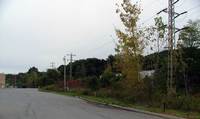
-
Poughkeepsie & Eastern Railroad
The former railroad track bed goes under several roads, including route nine. Below nine the tracks border the McCann Baseball field and continue until they reach the Hudson River railroad tracks.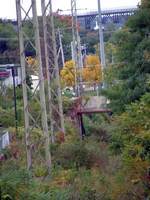
-
Poughkeepsie & Eastern Railroad
A small stream finds its way along the P & E route towards the Hudson River. View is from the CXS walking bridge on Marist east campus. Note the towers for power transmission. In times of heavy foliage, the towers are the best trail markers for the P & E route. Note dorms at left center (east campus) and Arteaga's Fitness Club beyond parking lot.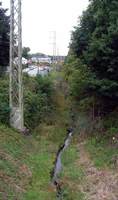
-
Poughkeepsie & Eastern Railroad
The Poughkeepsie & Eastern railroad first came through Marist lands in 1868-1872. It ran through several stages of success followed by failure followed by success, etc. The last passenger traffic for the Pleasant Valley station occurred in 1937. Since that time the tracks through the Marist property were used to service the Hudson River State Hospital, Western Publishing Company, Shatz Federal Bearings, and several smaller industries, including foundry and slaughter house. Several spurs were built to connect these industries. Most of the spurs are gone, but evidence of their crossing streets like Fulton still exists. This service came from the Hudson River railroad, as the tracks from Pleasant Valley were torn up and the right of way sold. Today the right of way along this path is owned by CSX railroad. Negtiations have been conducted between CSX and Dutchess County to transfer the unused land to the County for use as a walking trail.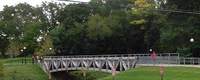
-
-
Omega Mansion
Landscape image from east of Omega Mansion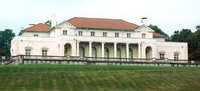
-
Demolition of Winslow Mansion - 1954
The tower was built away from route nine towards the river, to give viewers in the tower an unobstructed view of most of the four mile stretch of the Hudson. In particular Winslow used the tower to point out to prospective investors in the Poughkeepsie Railroad Bridge its probable location. Houses in the far distance are along the western shore of the river.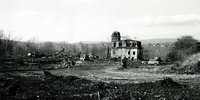
-
Demolition of Winslow Mansion - 1954
The tower was firmly attached to the mansard roof. The smokestack at right belonged to Western Publishing which occupied the space now used by Home Depot across the street from Marist College main campus.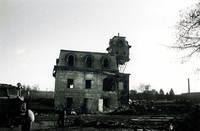
-
Demolition of Winslow Mansion - 1954
This photo shows windows in the mansard section very similar to those at the top of the wood tower, which leads me to believe they were both added to the original structure at the same time. The 'stone' in the descriptions was really brick. This is consistent with the existing buildings in downtown and riverside Poughkeepsie, as there was a large supply of clay to make bricks. At least two brick factories are cited in the deeds related to Marist College land. There was an addition of only one story at the foreground. This shows rough fieldstone. It may have been an addition during the Winslow era. Winslow was intrigued with Victorian wood structures. Rather than demolish the Crosby house, he surrounded it with a wooden facade. A large chunk of the facade is visible in the lower center of this photo.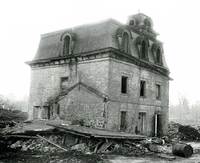
-
Demolition of Winslow Mansion - 1954
The Winslow house as it was being destroyed in 1954. This photo shows the lower floors in brick rather than fieldstone, and the tower in wood from the foundation. There is also a mansard upper floor. This probably was commissioned by John Flack Winslow, but might have been built by the previous owners, the Crosbys. The mansard roof originated in the 17th century in France, but became very popular in the 1852-1870 period. The French government assessed house taxes on the number of floors in the building. The mansard was really an attic, with no stonework (the chimney likely dates back to the Crosbys) so was free of the tax. Each side consisted of two faces, the lower one tall and steep, the higher one closer to parallel and short, which made it difficult to see from street level. Coincidentally, the mansard roof was introduced to New York City by Detlef Lienau, the architect for the Bech buildings. Although Danish by birth, he studied woodworking in Germany and worked for several years with the French railroad before coming to the United States. He used the mansard roof for the Shiff house he designed along Fifth Avenue near 11th Street.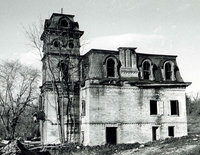
-
Winslow estate drawings
The main house was a stone house, but John Winslow wanted Victorian wood, so he encapsulated the house in a Victorian wooden frame. To this he added a tall tower that enabled visitors to obtain a view of four miles of the Hudson River, including the proposed location of the long awaited Mid Hudson Railroad Bridge. Winslow participated by inviting prospective investors to Poughkeepsie and showing them the possibilities (and possible convincing them to invest. After all it was a private enterprise!) The view from hyde park road shows a greenhouse at the extreme right. Unknown is what the tall building between the main house and greenhouse with the tower represents. The second woodcut depicts the view from the main house towards the river, and an impressive bridge. The grounds had several ponds.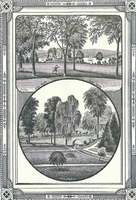
-
Winslow estate description
This sketch or photo shows the part of the Winslow house facing the Hudson River. Note the tall tower that John Winslow added to enable visitors to obtain a panoramic view of a four mile stretch of the river, including the site of the proposed railroad bridge across the Hudson. For some time Winslow as president of the bridge company and used his estate to encourage shareholding in the enterprise. Harriet Wickes Winslow resided at Wood Cliff until shortly before her death in 1926. She retained the estate, but moved with her long time companion Sophie Harris to 247 Church Street sometime after 1920 to be close to her Presbyterian Church and medical assistance. This is the only reference to Roderick C. Andrus that I found. I still have not cross checked this statement at the Dutchess County records. The property was part of the Hermanse & Sanders patent, not the Great Nine Partners patent.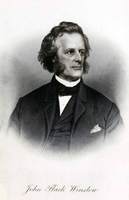
-
Erastus Corning
Erastus Corning (1794 - 1872) took John Flack Winslow (1810 - 1892) into partnership in 1837 when Winslow was only 27. Corning had extensive interests in several industries including hardware, iron, railroads and banking. He probably recruited Winslow because of Winslow's knowledge of the iron industry. The partners operated the Rensselaer Iron Works and the Albany Iron Works, introducing the bessemer process in 1865.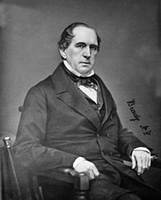
-
John Flack Winslow
John Flack Winslow (1810 - 1892) became a younger partner to Erastus Corniing in 1837. The two operated the Rensselaer Iron Works and later the Albany Iron Works. In 1860-1861 Winslow engineered the construction of the ironclad ship Monitor for the Union forces. In 1865 he became president of Rensselaer Polytechnic Institute, donating half the cost to a science building in 1866. He resigned the presidency in 1868, after he had relocated to Poughkeepsie NY.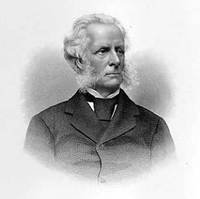
-
Future traffic pattern ?
The north entrance to Marist College may see changes in a design by the New York State planners. The photo shows the current entrance, and another set of lights normally blinking yellow about 200 feet north of the main lights. The blinkers have a sign indicating John winslow Gate Rd. Drivers coming from Hyde Park wishing to shop at the Office Depot/McDonalds/Staples shopping center often make the left onto this road to avoid the main light. The Winslow sign points out the southern entrance to the former Winslow farm east of route nine. The farm was incorporated into the Hudson River State Hospital grounds, but nothing major was ever constructed on the farm, which extends east to Violet Avenue. The purchasers of the State Hospital filed plans for 900 housing units on the hospital campus. To reduce entries and exits onto route nine, the state planners suggested a connector road on the Winslow farm reaching from route nine to Violet Avenue. All vehicular traffic from the former Hospital grounds would be routed to this connector road, then move to either Violet Avenue or route Nine. The existing traffic lights at Marist College and McDonalds would be closed off. Marist would create a replacement entry/exit about 200 feet north on the former Newbold estate property leading to the new traffic light. There are two glitches to this grandiose plan. First, the drop in the economy since 2007 has brought new housing in the area to a virtual halt. Second, the fiscal status of the State discourages new roads. I have been told that the parties who purchased the State Hospital grounds now have placed it on the market. So don't hold your breath...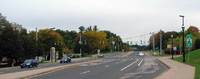
-
Winslow farm
In December 2012, Bob Pomerantz, college electrician, told me he had discovered the outlet for the Winslow stream. It exits this culvert between the parking lot for the Gartland athletic fields and the Poughkeepsie Water Works (along with several other culverts which remain dry except for rain storms - the Winslow stream always flows). The stream follows an overgrown path past the Water Works and Gartland Athletic until it flows under the railroad tracks and into the Hudson River. Although the stream originally found its way onto the Barnard/Marist Brothers land, it was diverted during the construction of the 1980-2000 period to remain on the Winslow property. (Photo taken 6 December 2012).
-
Winslow farm
This culvert takes the stream water under route nine near the Fontaine Academic building. I could not find evidence of the stream on the Marist Campus, so it must be carried towards the Hudson River via underground pipes.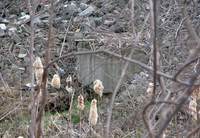
-
Winslow farm
The stream still running through the Winslow farm is marked to begin on the northeast corner of the Ziegler farm, same size as and just north of the Winslow farm. The stream crossed over to the Winslow farm, then ran under the Hyde Park road to Winslow's estate on the now Marist Campus. Winslow created two or three ponds on his estate, one of which had a small island the same shape as the famed ironclad Monitor. The stream crossed over into the Marist Brothers' property. The Brothers dammed the stream and used the water power to generate 1100 watts of electric power, enough to provide lighting to the former McPherson house. (ed.note I think the electricity was direct current that could be stored in batteries.) From the Brothers' property the stream emptied past the Poughkeepsie Water Works into the Hudson River.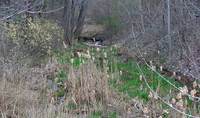
-
Winslow farm
The entrance to the Winslow farm. The house may date back to the Winslow era, as when the farm was taken over by the Hudson River State Hospital, no construction was ever done on this farm. This is why running a connector road through the Winslow farm between route nine and Violet Avenue is a future possibility. In addition to farming, Winslow provided housing for his servants.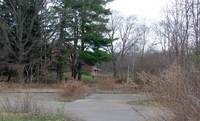
-
Winslow farm
This sign across route nine from the northern section of Marist College marks the beginning of the Winslow farm, which was east of route nine and extended as far as Violet Avenue.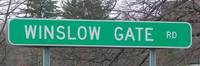
-
Winslow estate orientation
The Winslow parcel is 27 acres taken from the original Barnard farm purchase of 100 acres - approximately one third of the property. The 100 acres was reduced by land taken by the Hudson River Railroad company around 1848 and by the Poughkeepsie Water Commissioners on several occasions beginning in 1871. The cross lines are not parallel, as shown by the sketch below of the Winslow parcel. The upper boundary is the stone wall separating the Winslow section from that owned by the Newbolds (1861 - 1946). The lower dividing line starts just below the Fontaine Academic building near route nine and heads west between the Gartland Athletic Fields and the Foy Townhouses.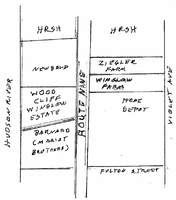
-
Paths heading north along river
Two of the many paths in the woods extending north as far as Quiet Cove, the park developed from the lower portion of the Hudson River State Hospital. There are many trails that give the pedestrian a variety of views. This picture was taken in March 2009 with the river clearly visible. Normally during the summer months the river is shrouded from the viewer, except for two special lookouts along the path on the left of this photo. When winter comes, the paths remain open allowing different adventure minus autos, skidoos, etc. So it's a nature walk. Do the words tranquil and serene come to mind?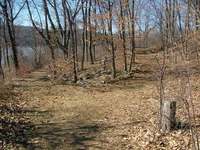
-
Dividing Wall
This is part of the wall dividing the former Newbold estate from the former Winslow estate.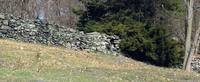
-
Carport at Carriage House
Dr. George Way added this three bay carport to the original carriage house. He used rock debris from the remnants of the original house to match the rock on the face of the carriage house, but more importantly to reduce the amount of cement needed to form the floor, the piers, and the tall retaining wall at the far end of the carport. The dark structure barely visible at the far end of the carriage house is an addition that provided office space and a back porch to the residence. Just beyond the wood stockade fence at the left of the photo is a pool and stairway down to the back of the carport and house. The photo below shows part of the back wall of the carport.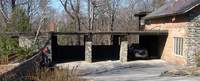
-
Porch and office addition to the Carriage House
This unusual addition to the carriage house was authorized by Dr. George Way. It provided a porch at the ground level and an office at the upstairs level. The structure was supported by posts at the left because of the severe drop off of land just behind the carriage house. Note the cement retaining walls at the right. They contained much rock rubble Dr. Way obtained from the site of the original main house on the Newbold estate. It is unknown whether the main house existed when it was part of the Pells farm or constructed by the Newbolds. But the main house was demolished before purchase of the property by Charles Chlanda in 1946. The dark structure just beyond the light colored plywood floor of the porch is part of the original carriage house. The retaining wall at the far right reaches up to the floor level of the carport.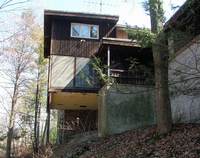
-
Windmill near Gardener's Cottage
These remains of a windmill used to pump water from a pond at a lower elevation up to the level of the gardener's cottage, part of which with red siding is evident at the left center of this photo. The windmill was used in the nineteenth century before electricity. The Newbold estate had several greenhouses at the lower level, but only remnants remain. A New York State agricultural report of the Newbold estate indicates that only three acres is cultivated, with the remaining 17 acres described as woodland. The Newbold family spent most of the time in New York City, with this property a refuge from the noise and sickness which was common in New York City during the summer time. No remains of the windmill vanes or piping can be found. The deformation of the shingles in the area just below the smaller window may have been indicative of a lookout porch attached to the windmill at that height. The pond at the lower section of the property still exists, and empties into the Hudson River.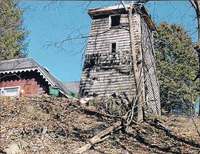
-
Newbold Gardener's Cottage
The gardener's cottage is on the same level as route nine, with a sharp drop off behind it to the lower section of the Newbold estate. The greenhouses were located behind and below the cottage. It is not known if the gardener lived year-round here. The windmill just behind the cottage and to the left from this viewpoint was used to draw water to this level. The gardener may also have acted as a caretaker, although there was a smaller house on the estate reserved for a year round worker. This cottage lies on a four acre parcel along route 9. It is owned by Ted Vanikiotis, the proprietor of the Palace Diner; he rents it to Marist College students.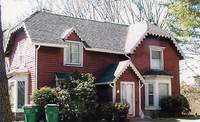
-
Newbold Caretaker's House
The caretaker's house is sometimes called the Fischbach house after one of the owners who purchased the house from Charles Chlanda after Chlanda bought the Newbold estate in 1946. It ran through a succession of owners until it was purchased by Marist College. The building sits close to route nine, just outside the stone wall at the right in this photo. The house is currently occupied (2012) by Marist Brother Don Kelly, a teacher of mathematics at the college.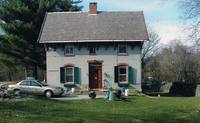
-
Reilly cottage
William and Mary Reilly lived on North Bridge Street in the City of Poughkeepsie when Charles Chlanda designed five small parcels on the upper flat part of the former Newbold estate. They chose the center parcel and built this cottage. Chlanda changed his mind about developing five sites, and took the remaining sites off the market. William (1911 - 1997) and Mary (1919 - 2010) lived in this cottage until their deaths. Mary died 2 December 2010. Brother Donald Kelly looked after her in her last years. Their children continue to own the house, which is situated just north of the Winslow portion of the Marist Campus. Part of the Fontaine Academic Building can be seen (very faintly) at the extreme left of this photo.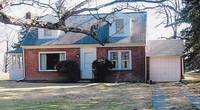
-
Boundary road
This road is the boundary between the college owned land and the four acres owned by another containing the gardener's cottage and ancient windmill; the cottage was out of the photo at the right. The road is about twenty feet below the level of the carriage house and gardener's cottage, with the steepest depression along the gardiner's cottage & college border.. The tracks in the road show that it is used by college maintenance personnel to deposit waste from the campus excluding metals and other materials, but including leaves, tree clippings, etc which are environmentally safe. The road eventually led to some greenhouses. I was unable to fix the exact location of the greenhouses. Mrs. Newbold reported in 1893 that only three acres were cultivated with the remainder woodland. It seems likely that the Pells who owned this lot before the Newbolds used the acreage between the turnpike road and river as their home with the remaining 126 acres across the turnpike a working farm, much of which became the Winslow and Ziegler farms.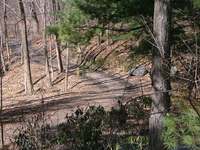
-
Bellefield east elevation
Bellefield was purchased by Thomas Jefferson Newbold in 1885. It stands on the Franklin Roosevelt property between the Roosevelt home and route 9 and is visible from route 9, the Albany Post road. When Newbold purchased the lot, the house was much smaller. He used McKim, Mead and White architectural firm, to add left and right wings with each the size of the original house. He also commissioned Beatrix Farrand to design the garden. She was a renowned landscape designer; among her other work is the Morgan library in New York City (which she supervised for 30 years after the original development). Beatrix was the daughter of Frederick Rhinelander and Minnie Jones. She operated from her mother's house on 11th Street in Manhattan. Bellefield is the only known work on which McKim, Mean and White, the best known society architects, worked with Beatrix, the outstanding landscape and garden designer. The Farrand-designed garden is behind the stone wall at the extreme left of this photo. A volunteer group is working to restore the garden to its original beautiful state. As the group removes overgrowth, it discovers plantings dating back to the Beatrix Farrand era.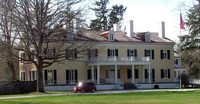
-
Bellefield - west elevation
Bellefield was purchased by Thomas Jefferson Newbold in 1885. It stands on the Franklin Roosevelt property between the Roosevelt home and route 9 and is visible from route 9, the Albany Post road. When Newbold purchased the lot, the house was much smaller. He used McKim, Mead and White architectural firm, to add left and right wings with each the size of the original house. He also commissioned Beatrix Farrand to design the garden. She was a renowned landscape designer; among her other work is the Morgan library in New York City (which she supervised for 30 years after the original development). Beatrix was the daughter of Frederick Rhinelander and Minnie Jones. She operated from her mother's house on 11th Street in Manhattan. Bellefield is the only known work on which McKim, Mead and White, the best known society architects, worked with Beatrix, the outstanding landscape and garden designer. The Farrand-designed garden is behind the stone wall at the extreme right of this photo. A volunteer group is working to restore the garden to its original beautiful state. As the group removes overgrowth, it discovers plantings dating back to the Beatrix Farrand era.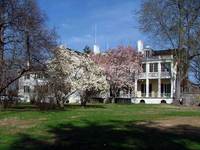
-
Path towards college athletic fields
This path is characteristic of the many paths on Fern Tor. It is part of a path which followed the Hudson southwards, then curved back and up to the main house level. Mrs. Reilly told me that the Newbolds used the many paths for carriage rides which would start and end at the main house. Note the wall separating the regular college from Fern Tor. The paths and two nice lookouts over the river provide a peaceful difference between the hectic and often noisy atmosphere of a college campus. The portion of the athletic field closest to Fern Tor has been improved since the time of this photo to provide a varsity level field for softball, still allowing a large tract of level space for intramural athletics.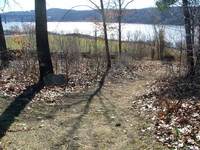
-
Newbold Main Entrance
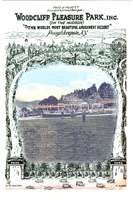
When the Newbold was a private estate, it has its own entrance and exit to route nine. The stone wall dates from the Newbold era. The mailbox was used by Mrs. Reilly until her death in December 2010. When the Winslow estate was turned into the WoodCliff Pleasure Park, this entrance may have been gated.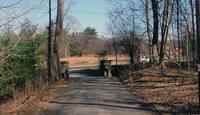
-
The Newbold parcel called Fern Tor
The Newbold parcel is a 13 acre parcel at the north end of Marist College located between Route Nine and the Hudson River extending to the former Hudson River State Hospital grounds now called Quiet Cove. It begins just north of the Winslow parcel, along a stone wall visible from the south.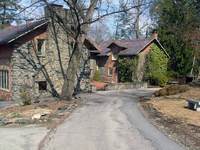
-
Hermanse & Sanders Patent Early deeds
In 1686 a patent was granted to Mynert Hermanse and John Sanders for land along the Hudson River in the Dutchess County area. It was described as beginning at where the Fallkill Creek enters the Hudson (creek entrances were considered permanent landmarks) and moving directly east to the Wappingers Creek, which had turned north from where we think of Wappingers. The northern boundary was where the Indian makes his tent along the Hudson (now called Quiet Cove and better recognized as the former Navy Boathouse during the Poughkeepsie Regatta times) The line extended due east till it reached Wappingers Creek. It essentially separates the current town of Hyde Park from the town of Poughkeepsie.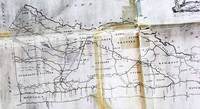
-
Overview of the Maristland Project
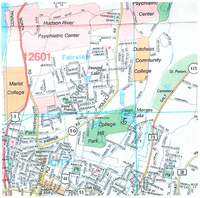
Maristland project describes the various parcels of land under and near the current boundaries of Marist College, as well as details some of the individuals who lived on the land and who were important to the history of the land or of Dutchess County. All of the land under Marist College was part of the 1686 patent granted to Mynert Hermanse and John Sanders. We have been able to track almost all of the land transactions from that patent to the present day. This project will concentrate on the individuals deemed most important to the history of the land and the College. The basic section of the campus lies between the Hudson River and Route 9. The white area just above the yellow marked Marist College now belongs to Marist, so the land stretches north the the pink section which is now Quiet Cove. The horizontal line between the words Hudson River and Psychiatric Center is the border line between the Town of Poughkeepsie and the Town of Hyde Park. Besides the basic section, the College has expanded east across route 9 in a rectangle bordered by Fulton Street on the north and West Cedar Street on the south, Route 9 on the West and Fairview Avenue on the east. Note the location of St. Peter's Cemetery. The Fallkill starts eastbound from the Hudson near Mount Carmel Church, but then turns north and runs along the back road of the Cemetery. This is important to us because the Poughkeepsie & Eastern Railroad, organized by John Flack Winslow ran along the back road of the cemetery, then U-turned north to the Hudson River Psychiatric Center, then U-turned south passing through the east-of-nine sections of the present campus and forming the border of Marist land east of the McCann Baseball field and the McCann Athletic Center. Note also the location of Morgan Lake. The three hundred acres east of Route 9 and beyond Morgan Lake was once owned by Elizabeth McCarty Bech, Edwin Bech's widow. It became the area now called Fairview, which includes Marist-east-of-9 To simplify treatment of the Maristland project, I have designed several logical sectors, which correspond partially to the land areas. The major areas (Newbold, Winslow, Barnard, Bech and Myers) are contiguous, with the Water Works Road separating the Barnard and Bech parcels. River and railroad parcels are bunched together, but the railroad parcels also include the spur of the old Poughkeepsie & Eastern. The circle marked Odd Lot is a collection of minor parcels important to the history of the college but not key to its major functions. The reader ought to refer to both these maps as he/she plows through the remainder of the project.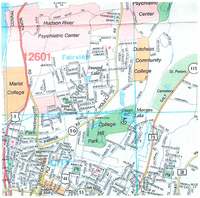
-
Stanford White
Stanford White was murdered in 1906, so had no direct influence on the Esopus project. However, he was a favorite of Oliver Payne. The records of White's correspondence in the Avery Library contain several hundred short notes to Payne. White joined the partnership of McKim, Mead & White in 1880, and the firm became the most prominent firm in the USA, catering to the leaders of the Gilded Age until well after 1910. It is not clear who did the renovation designs for the Stevens mansion at 57th and Fifth Avenue which Payne gave to William and Flora Whitney. We know that Payne moved into his own townhouse at 852 Fifth Avenue in 1903. While Curtis Channing Blake indicates Carrère & Hastings did work for Payne in New York City, we have no other record of this work. Stanford White specialized in the interior design of projects, while McKim concentrated on externals. It is know that White designed the staterooms and Payne's private rooms on the yacht Aphrodite built in 1898. Payne gave White great freedom of design and also of decoration. My best guess is that McKim, Mead & White designed Payne's townhouse at 852 Fifth Avenue, and White worked closely with Payne on the interior design and decoration. By 1902 McKim, Mead & White were awarded the design of the house Oliver Payne wanted to give Payne and Helen Whitney as a wedding gift. The construction began in 1904 and lasted five or six years. I don't know why Payne turned away from McKim, Mead & White and employed Carrère & Hastings for the Esopus estate; perhaps he did not have the same confidence in McKim and Mead; perhaps Carrère & Hastings' reputation had grown substantially by 1909. Among important works attributed to Stanford White is the Washington Arch at the bottom of Fifth Avenue, the second Madison Square Garden, and the Boston Public Library.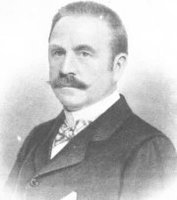
-
-
Sojourner Truth
The evangelist and reformer Sojourner Truth ( legal name Isabella Van Wagener) (born circa 1797 - died 26 Nov1883 in Battle Creek, Michigan) was born and lived in West Park, which then was part of New Paltz. Isabella was the daughter of slaves and spent her childhood as an abused chattel of several masters. Her first language was Dutch. Between 1810 and 1827 she bore at least five children to a fellow slave named Thomas. Just before New York state abolished slavery in 1827, she found refuge with Isaac Van Wagener, who set her free. With the help of Quaker friends, she waged a court battle in which she recovered her small son, who had been sold illegally into slavery in the South. Sojourner Truth towards the end of her lifeAbout 1829 she went to New York City with her two youngest children, supporting herself through domestic employment Since childhood Isabella had had visions and heard voices, which she attributed to God. In New York City she became associated with Elijah Pierson, a zealous missionary. Working and preaching in the streets, she joined his Retrenchment Society and eventually his household. In 1843 she left New York City and took the name Sojourner Truth, which she used from then on. Obeying a supernatural call to "travel up and down the land," she sang, preached, and debated at camp meetings, in churches, and on village streets, exhorting her listeners to accept the biblical message of God's goodness and the brotherhood of man. In the same year, she was introduced to abolitionism at a utopian community in Northampton, Massachusetts, and thereafter spoke in behalf of the movement. She supported herself by selling copies of her book, The Narrative of Sojourner Truth, which she had dictated to Olive Gilbert. Encountering the women's rights movement in the early 1850s, and encouraged by other women leaders, notably Lucretia Mott, she continued to appear before suffrage gatherings for the rest of her life. In1864 she went to Washington, where she was received in the White House by Abraham Lincoln. By 1875 she retired permanently to Battle Creek, Michigan, where she remained until she died.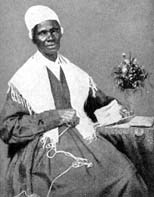
-
Holy Cross Monastery
Holy Cross Monastery is one of five houses of the Order of the Holy Cross, a Benedictine monastic community for men within the Episcopal/Anglican Church founded in 1884. In addition to Holy Cross Monastery, priories are located in Berkeley, California and Toronto, Ontario. There are monasteries in Santa Barbara, California, and Cape Coast in Ghana (West Africa). The Monastery is located on the Hudson River in West Park, NY, just south of the Payne property. Each local community adapts the monastic life to contemporary conditions and local needs and may include a variety of ministries and works by which it supports itself. Holy Cross Monastery buildings consist of two guest houses, a refectory, the monastic enclosure and the monastery church of St. Augustine. The buildings are historicsites on the National Historic Register. The Order of the Holy Cross is an Anglican monastic community within the Benedictine tradition. The Order was founded in 1884 by the Rev. James O.S. Huntington and is comprised of five houses in the United States, Canada, and South Africa. The monks live in community under the three-fold vow of obedience, stability, and conversion to the monastic way of life as stated in the Rule of St Benedict. Their life in community also reflects the Rule of their founder, Father Huntington. Daily life includes monastic offices and a daily eucharist and attempts to provide stability through a balance of work, recreation, prayer and study. Each House has a different emphasis of ministry, but prayer through the daily offices, the Eucharist, and private devotion is the centerpiece of their activity. The Associates of Holy Cross are men and women seeking to live a devout life in the world. They follow a Rule of Life, and assist the Order both ministerially and financially. Ministry and Work The principal work of the monastery is in guest ministry through scheduled retreats for guests throughout the year, as well as providing space for individual and group retreats. Enterprises The monastery operates several enterprises including Holy Cross Incense, Holy Cross Publications, and the Monk's Cell gift and book shop.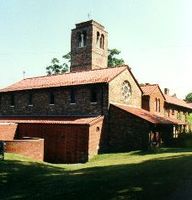
-
Ascension Cemetery
Ascension Cemetery The cemetery one-quarter mile north of the Church of the Ascension had been established in the early 1840s. Robert Livingston Pell donated some land on the northern edge, The cemetery figures in many of the deeds because the southern border of the cemetery lies along the division line of lot #11 and lot #12 of the three mile or River lots of the New Paltz Patent, and formed the division between the Russell properties and the Pratt properties. Few of the families which figure in our history are buried there, as most of them lived in New York City and were probably buried there. However, Dr Richard Gordon and his wife are buried in the southeast corner. I was unable to locate any Pell burials. However, there are Beavers and Terpennings. The cemetery is well cared for, but the extreme western section is overgrown, and the ground is covered with pachysandra. The monuments in that section seem much older than those in the eastern half. There are still burials in the cemetery. One interesting row is for seven Sisters or Nuns. I have not been able to locate their convent. One source suggested Vails Gate near Newburgh, a second source suggested Kingston.
-
Church of the Ascension
In the early 1800's worshippers in the town of Esopus on the west bank of the river traveled by ferry to Hyde Park to attend services at St. James. After an unfortunate ferry accident on a cold January morning, in which one person drowned, the Rev. Dr. Sherwood of St. James worked actively to establish a church in Esopus. The parish was organized on April 4, 1842, and Dr. Sherwood laid the cornerstone for the church on July 19th. The east entrance of the church was designed to align exactly with the west-facing entrance of St. James. Mrs. Anna Watts of the Stuyvesant-Rutherford family in New York City donated money for the construction, and her son-in-law, Archibald Russell, commissioned New York architect John Johnston to design the building. On November 12th the stone church, built in the Gothic style and overlooking the Hudson, was consecrated by the Bishop of New York. Mrs. Watts also reportedly named the church 'Ascension' because she also attended the well-known Church of the Ascension in New York City (Fifth Avenue at 10th Street), which had been completed in 1841. Ascension Church viewed from west or Hudson River side. The front door faces directly opposite St. James Church in Hyde Park. During the first several years, services were held in the church only in the summer months because the majority of active members and supporters were summer residents from New York City and Brooklyn . In 1860, John Jacob Astor III donated money for the construction of the rectory when he occupied the southern section of the Payne property. Oliver Hazard Payne donated money for the sexton's house directly south of the church and also to electrify the church. Soon after the Civil War, the family of General Daniel Butterfield joined the parish. The General donated items in the church in memory of his wife who died in 1877 and of their only child Edgar, who died at the age of three. Stain glass windows were installed in 1916 in memory of Sarah Brookman and Harriet Carlton Durkee -- related to the Durkees who owned part of the Payne property. The sister church of Holy Trinity in Highland began regular services in 1870 in borrowed halls. The congregation began building a church in1872 and it opened for services June 1873. The architect was Richard Upjohn, from England, who with James Renwick were the two most famous church architects, both specializing in Gothic and English country architecture. Upjohn had been the architect for the New York City Church of the Ascension (1841) and Trinity Church (1946). He was one of the founders of the American Institute of Architects and served as its first President. Renwick's most famous work is St Patrick's Cathedral in New York City., but he also designed several buildings at Vassar College as well as the Smithsonian in Washington DC. In the early 1930's the Church of the Ascension and Holy Trinity parish in Highland began sharing rectors, and they were legally united in 1963. The parishes are now served by one vestry and are under one financial system. The current pastor is The Rev. Jennifer Barrows, who began her service in June of 2001. So the Russells, the Astors, the Durkees, and Payne were all associated with the Church of the Ascension. For further information see www.esopus.net/ascension.htm